FOSSEE Events

  • Physical Computing with Arduino: From Idea to Intelligent Systems:

    The hardware team under the FOSSEE Project in association with  the Post Graduate Academic Council (PGAC) at IIT Bombay conducted the session “Physical Computing with Arduino: From Idea to Intelligent Systems”, on 28th March 2026. It introduced participants to the journey of transforming ideas into functional, intelligent hardware systems. The workshop started with the basics of Arduino and progressed to advanced experiments in simulation mode, enabling participants to understand concepts step by step. It focused on integrating programming with real-world electronics, demonstrating how ideas can be prototyped through simulation and then implemented as working systems. Participants explored hands-on examples, design thinking approaches, and practical applications in areas such as IoT, automation, and smart devices. The session aimed to inspire students to move beyond theoretical learning and actively build innovative solutions, fostering a mindset of experimentation, problem-solving, and open-source collaboration. More than 50 students participated (both in-person and online modes) for this workshop.

  • FOSSEE Arduino Day 2026:

    The FOSSEE project is celebrating the FOSSEE Arduino Day from 23 to 25 March 2026. Inviting both school and college students to be a part of India's biggest open-source hardware celebration. Whether, you are a school shaping young innovators or a college building real-world solutions, all are welcome. Give your students hands-on exposure to Arduino and Open-Source Hardware with guidance from the FOSSEE open source hardware team. FOSSEE is providing a platform for college students to showcase their innovation to the nation. Do participate and get the benefits of this unique opportunity! Know more about the event at: https://arduinoday26.fossee.in.

  • Hands-on Workshop on Blender, in Collaboration with PGCA, IIT Bombay:

    The FOCAL team under the FOSSEE project conducted a hands-on workshop titled “Blender: Introduction to 3D Modeling and Basic Engineering Modeling and Animation”, organized by Post Graduate Academic Council, IIT Bombay, on 21 and 22 March 2026. Blender is a free and open-source 3D software that supports multiple platforms, including Windows, macOS, and Linux. It is widely used for 3D modeling, animation, rendering, visual effects (VFX), and game asset creation. This hands-on workshop was designed as an interactive and experiential learning session, enabling participants to develop practical skills through active participation rather than traditional lecture-based instruction. 

  • eSim Hands-on Workshop in Collaboration with PGAC, IIT Bombay:

    The eSim Team, in collaboration with Post Graduate Academic Council (PGAC), IIT Bombay, conducted a Hands-on Workshop on the Open Source EDA Tool eSim at LC002 on 18th March 2026, from 2:00 PM to 5:00 PM. The session was led by the eSim team members of the FOSSEE project.
     
    The workshop provided practical exposure to electronic circuit design and SPICE-based simulation through guided demonstrations and hands-on exercises. It witnessed active participation from around 20 students from B.Tech, Master’s, and PhDs from IIT Bombay and other institutes, along with staff members, including international attendees from Myanmar. The session was highly interactive, with queries and doubts effectively addressed, making it an engaging and impactful learning experience for all participants.
  • Basics of OpenFOAM workshop at Azeotropy 2026:

    The FOSSEE CFD team conducted a workshop on the Basics of OpenFOAM workshop at Azeotropy 2026-Chemical Engineering Symposium, IIT Bombay on 14th March 2026. Participants learnt how to use OpenFOAM to solve a problem in CFD (a Case). They could simulate and run a Case during the workshop. 75 Chemical Engineering students attended the workshops at the Bytes Lab of IIT Bombay. 

  • eSim Camp on Research Migration – Empowering Open-Source Research in Electronics:

    The FOSSEE - eSim  team conducted a half day online workshop on eSim titled eSim Camp on Research Migration – Empowering Open-Source Research in Electronics in collaboration with the Dept. of Electronics & Communication Engineering (ECE), Sahyadri College of Engineering and Management, Mangaluru, Karnataka. This session focused  on introducing the capabilities of eSim 2.5 and educate the students on the process of migrating any published research work into the open-source simulation ecosystem, using eSim. The session was attended by around 200 students along with the faculty members. This session aimed, to encourage the students to contribute to open source, and build simulation competency aligned with industry standards. 

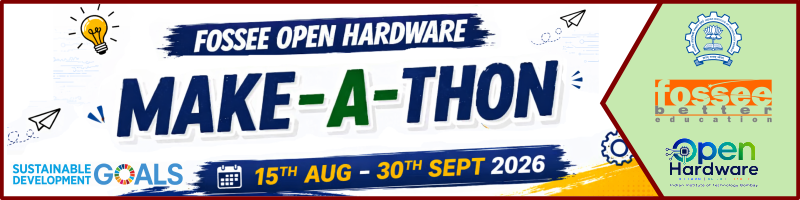
  • FOSSEE Open Source Hardware Hackathon 2026 :

    This initiative aims to encourage students to design and develop open, reproducible hardware solutions addressing real-world challenges in areas such as Healthcare, Energy, Smart Systems, and Sustainable Development, using open-source tools and methodologies.

    This hackathon provides students with an opportunity to:

    • Work on real-world problem statements using open-source hardware platforms

    • Develop functional prototypes with proper documentation

    • Learn best practices in open-source licensing and hardware design

    • Receive mentorship and guidance from FOSSEE and domain experts

    For registration & other details, please visit: https://oshw26.fossee.in.


  • eSim Camp at JSPM's Jayawantrao Sawant College of Engineering, Pune:

    An eSim Camp was successfully conducted at JSPM's Jayawantrao Sawant College of Engineering, Hadapsar, Pune, Maharashtra on 13 February 2026. Around 100 students from the Electronics and Telecommunications department attended the session.  The camp included a hands-on session on eSim where students gained practical exposure to circuit design and simulation. Various academic, research, and project opportunities that can be explored through eSim were also discussed.  The Principal and the Head of the Department (Electronics and Telecommunication) were also present with their continuous support and encouragement throughout the event. Their guidance and cooperation were instrumental in ensuring the smooth execution of the camp.

  • DevConf.IN 2026 in Pune:

    The DevConf.IN 2026 was hosted at MIT World Peace University, Pune on 13 - 14 February 2026. The eSim team of FOSSEE project, delivered a session titled “eSim: Building an Open-Source EDA Ecosystem for Education, R&D, and Community Innovation”. The session was attended by around 40 participants. The talk introduced eSim as a fully open-source Electronic Design Automation (EDA) toolchain for analog, digital, and mixed-signal circuit simulation, built on established FOSS tools such as ngspice, KiCad, GHDL, and Verilator. The technical overview of eSim’s architecture, simulation workflows, portability across environments, and its evolving AI-assisted capabilities aimed at improving usability and debugging were also presented in detail. The session also highlighted how open-source EDA tools can support education, research, and community driven innovation, while aligning with national initiatives such as the Indian Semiconductor Mission and broader open digital infrastructure efforts.

  • Hands-on workshop on Scilab (in collaboration with PGAC, IIT Bombay):

    The FOSSEE project in collaboration with the Post Graduate Academic Council (PGAC) of IIT Bombay conducted a hands-on workshop on Scilab, a FOSS computational platform used for modelling, simulation and numerical computation. The workshop was conducted in the lecture hall complex of IIT Bombay on Saturday 31 January 2026. This workshop aimed to provide the students with a basic introduction to Scilab. The workshop was conducted using Scilab Spoken Tutorials to ensure effective learning of fundamental concepts. Around 21 post graduate students from various disciplines joined. Prof. Madhu Belur, a Co-PI of the FOSSEE project delivered a talk on the benefits of using open source software, particularly Scilab, instead of proprietary software such as MATLAB. He emphasized on how learning open source tools help students build stronger résumés, improve technical skills, and enhance employment opportunities. A demo of Scilab and the various activities under Scilab was given. The Spoken Tutorial videos of Scilab series were also shared with the students. They were given a detailed walk through on how to use this resource to learn Scilab. Overall, the feedback from participants was positive, and they showed enthusiasm for advanced workshops on Scilab in the future.

Pages